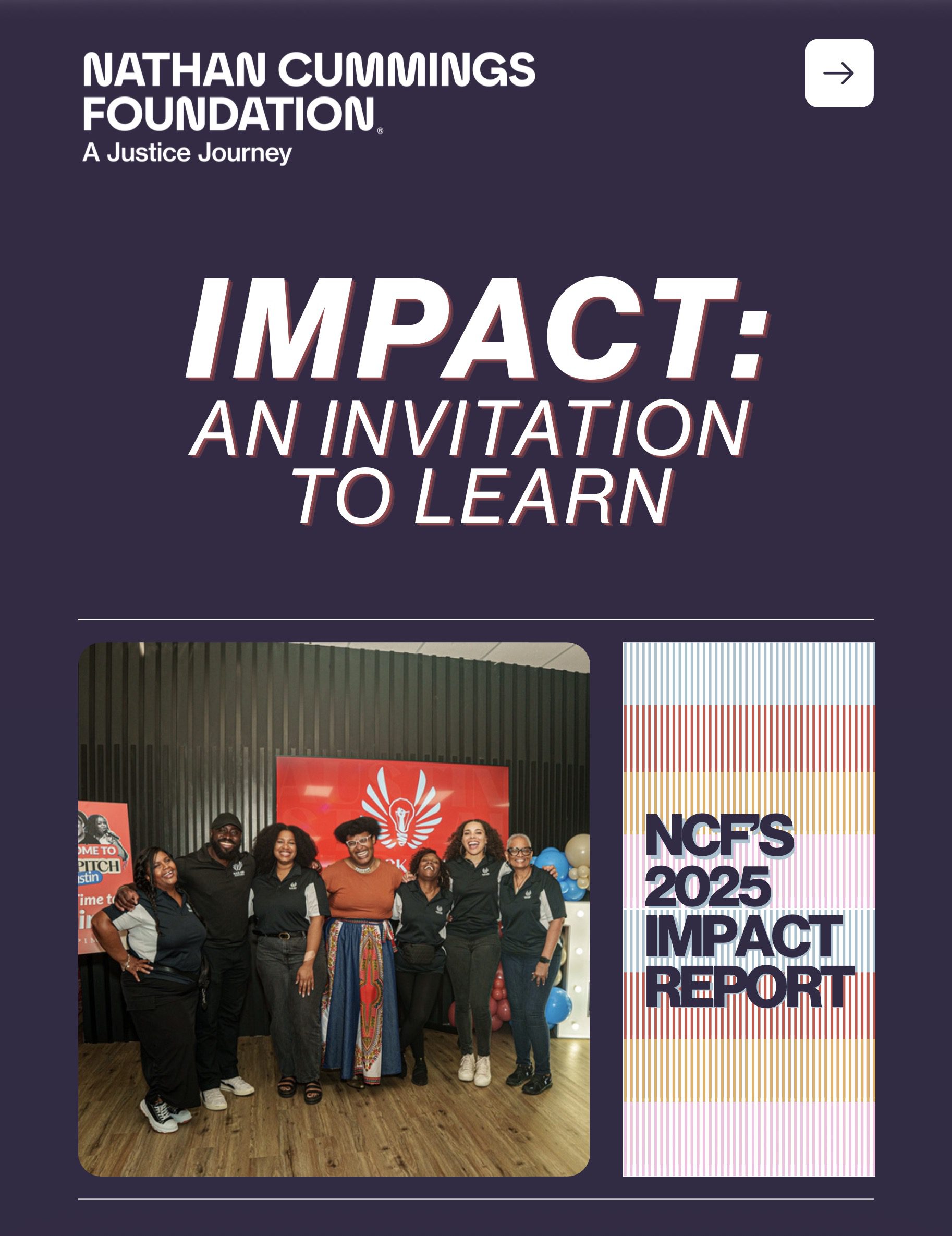
In 2022, when Nathan Cummings Foundation (NCF) decided to realign its work to a triple goal of Racial, Economic, and Environmental Justice (REEJ), we took a totality of assets approach to drive measurable impact, rooted in data. Beginning with grant-making and program-related investments, we also examined opportunities to build on NCF’s 2021 commitment to leverage 100% of the endowment in support of our mission.
Read the full Environmental Justice Lens
The field of “impact investing” has shown significant, sustained growth over the last five years. The Global Impact Investing Network, Inc. (GIIN) estimated that impact investing in the global market reached $1.571 trillion USD in 2024, with climate change being a significant thematic area across asset classes. However, every company makes an impact, and these investments represent approximately 1% of assets under management from the 500 largest investment managers. Furthermore, investments in decarbonization, the energy transition, and related industries are both essential to humanity’s long-term survival and proven to deliver strong returns. Yet every day, communities continue to bear the environmental costs of polluting industries with little incentive to curb air and water pollution, biodiversity loss, or soil contamination. These harms are not hypothetical or future-facing; they are affecting people and ecosystems today. Even aside from human and environmental considerations, these are material issues that also affect long-term shareholder value.
With this in mind, we asked two simple questions: 1) What kind of impact do we want to make through our investments? 2) What if we sought to assess the material environmental impacts of our investments, including the associated impact on human health and the ecosystems necessary to support life?
As we explored both opportunities and challenges in collaboration with our Outsourced Chief Investment Officer (OCIO), Bivium & Westfuller, together with internal program, impact, and finance teams, we found a lack of shared language, limited analytical tools, and few clear investment criteria focused explicitly on environmental and public health impacts. Yet the risks of ignoring these dynamics, including regulatory, reputational, financial, and moral are growing. At the same time, we also found investment opportunities across sectors and industries with co-benefits that advance environmental health, economic opportunity, and community resilience.
From the outset, our goal was to develop practical, investable guidance that could be integrated into real portfolio decision-making. Analysis and flexibility are core components of this work. That meant designing a framework that was rigorous enough to reflect our mission and flexible enough to operate across asset classes and strategies while continuing to generate market-rate returns. In close collaboration with our environmental justice and finance teams, and our OCIO, we drew on field research and data analysis and assessed challenges to implementation. The result is an investing framework that clarifies expectations, sharpens accountability, and creates a shared foundation for dialogue with managers while still allowing for the judgment required in complex, multi-asset portfolios.
In our view, environmental justice is not a niche concern or a values add-on; it is a critical lens for understanding material risk and long-term value creation in today’s economy. We’re being more intentional about the kind of impact we want to make through our investments and transparent about challenges and opportunities. We are guided in this journey by a set of principles that outline the spirit and intention behind our approach. We then turned to practical matters in implementation.
From Principles to Practice: Moving Beyond Traditional Impact Categories
One of the most important outcomes of this stage of our work was the evolution of our impact classification system. Rather than rely on the more commonly used “A/B/C” framework (Avoids Harm, Benefits Stakeholders, Contributes to Solutions), we developed a four-part framework that reflects a more nuanced approach designed to recognize thresholds of impact:
- Avoiding Harm remains our baseline. Investments in this category screen out investments that demonstrate habitual and material environmental harms.
- Mitigating Strategies establish a sustainability threshold, emphasizing corporate accountability and meaningful efforts to reduce harm, as well as responsible use of finite natural resources.
- Optimizing Strategies focuses on companies that intentionally assess environmental considerations in practice and embed solutions into core operations and value chains.
- Solutions represent our north star: businesses whose products or services directly advance environmental and climate outcomes.
This structure acknowledges that all investments have impacts, that tradeoffs are real, and that progress often happens incrementally. More importantly, it allows us to be explicit about our priorities at different points along the spectrum and provides flexibility to our investment team.
We have paired these commitments with concrete guidelines for manager assessment, considering intentionality, materiality, and engagement, and with detailed criteria that address pollution, resource use, labor conditions, community impacts, and transparency. We have also been explicit about the importance of recognizing unintended consequences and resisting “false solutions” that externalize harm rather than reduce it.
To our knowledge, this is among the most holistic and explicit attempts by an asset owner to operationalize environmental justice within a diversified endowment. It significantly raises the bar for what mission alignment and impact can, and should, mean in institutional investing.
Looking Ahead: Field Building, Not Just Portfolio Alignment
This work does not end with the adoption of a framework. In the coming year, we will integrate these criteria into manager conversations, align them with impact metrics, and incorporate them into our reporting and performance indicators. We also plan to repeat this process for racial justice and economic justice, completing the REEJ lens over time.
Just as importantly, we view this as a contribution to the broader impact investing ecosystem. Our aim is to help name what has too often gone unexamined, to share practical tools that others can adapt, and to encourage more investors to assess environmental impacts and examine the human, ecological and economic risks of negative externalities.
The future of impact investing will not be defined by intent alone. It will be defined by rigor, accountability, and a willingness to confront uncomfortable truths about how value has been created—and at whose expense. An environmental justice lens is not a departure from impact investing’s roots. It is an essential step toward fulfilling its promise.